HTTPS query and jobs APIs
BigQuery
Eligible query results collected as the client reads their pages.
Boundary: Storage Read API and other client paths require qualification.
 houdata.
CacheOLAP / Technical overview Private preview
CacheOLAP follows selected client requests to analytical platforms. It can observe statements and answer eligible repeated reads from a distributed result cache, subject to freshness and identity policy. This guide explains the preview's operating model; exact compatibility is established in an evaluation.
01 / Request path
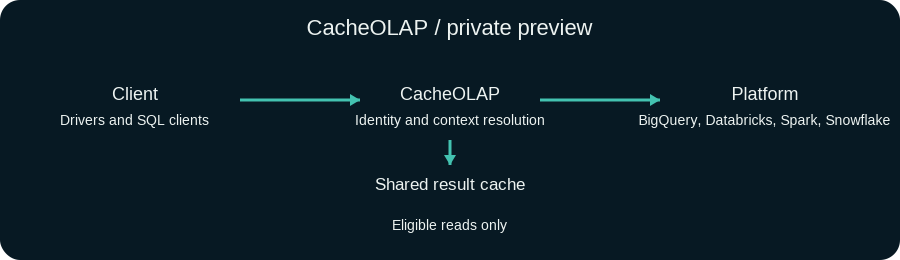
A qualified client points its connection or API endpoint at the corresponding CacheOLAP proxy. The proxy relays a request to the analytical platform when no eligible cached result can answer it. It observes the statement and the response along that path; policy can allow a later equivalent read to be served from the cache.
Each integration follows the client protocol it was built for. A platform name alone does not imply that every driver, API or result format is covered.
02 / Eligible results
Reuse is limited to reads whose request, identity and session context can be understood and whose response passes through the proxy in a form it can retain. The result must fit the configured size limit and be consumed to the point required by that integration. A miss, write, unsupported call or incomplete result continues to the platform.
Query text alone is insufficient as a cache key. Parameters, project or warehouse, database and schema, session settings, result format and identity can all affect the answer. The relevant fields differ by platform. Operators can set TTL and bypass policy for the reads they choose to evaluate.
03 / Freshness
Some writes pass through the proxy and can trigger policy-based invalidation. Analytical tables also change through scheduled loads, streaming jobs, tasks and other clients that bypass it. CacheOLAP cannot infer those outside changes from the traffic it sees.
An explicit TTL limits how long a stored answer can be reused. A preview should establish the maximum acceptable age for each candidate query, identify outside update paths and decide when an operator must clear results. A cache hit can be older than the current platform data until its policy expires or it is cleared.
04 / Identity and sessions
Platform roles, account permissions, active database or schema and session settings may change the result. The integrations follow those contexts in different ways. Some offer a per-principal cache mode; broader sharing requires an intentional permission boundary and should be evaluated with the customer's identities.
When a principal or session cannot be resolved, or a session changes in a way the proxy cannot safely track, the affected request is relayed without a cache hit. The private preview checks that behavior with the actual client and authorization model before enabling reuse.
05 / Integration paths
All four integrations are experimental. The descriptions below identify the intended path and a material boundary, not a blanket support statement.
HTTPS query and jobs APIs
Eligible query results collected as the client reads their pages.
Boundary: Storage Read API and other client paths require qualification.
SQL statement API and Thrift over HTTP
Eligible inline or small attached results on followed statement paths.
Boundary: Results delivered by external links are not captured.
Spark Thrift Server, binary or HTTP
Eligible reads after the client consumes the complete result.
Boundary: An early close or session state the proxy cannot follow prevents reuse.
Driver REST traffic and SQL API v2
Eligible results that pass through the proxy in full.
Boundary: Results downloaded from cloud storage or split into unsupported partitions are not cached.
Download a compatibility guide: BigQuery · Databricks · Spark · Snowflake.
Driver and platform versions, authentication, transport, response sizes and error behavior are qualified for the exact evaluation. Contact Houdata for detailed compatibility material.
Architecture
The request path is the same everywhere; identity, result handling and coverage differ by integration. On narrow screens, scroll the diagram horizontally to see the details.
06 / Evaluation
Start with one platform and a representative client. Record the query and parameter repeat rate, result size, direct latency, acceptable freshness, identity boundary and data update path. Then compare direct and proxied responses, enable reuse for eligible reads and inspect hits, misses, errors and repeat latency.
Where the platform reports backend work, compare it with requests served from cache. Any estimate of financial savings must use the platform's actual billing model and the customer's measured workload. The preview establishes suitability and limitations before wider use.
Explore analytical use casesConsole and enterprise integration
CacheOLAP is operated from the shared Houdata console. It adds a Work Saved panel that reports platform work spared in the units the platform reports, never converted to money.
OpenID Connect single sign-on with group-to-role mapping, and an audit log that can be forwarded over syslog in CEF or RFC 5424 to your SIEM.
Operational metrics, including per-target query executions, cache lookups and errors by statement kind, for your Grafana dashboards.
Agents use the console with a user's API token and permissions. Cached values are never returned, and changes are off by default and audited.
Private preview
Share the platform, client or driver, recurring query, result shape, update cycle and permission model. We will scope the evaluation around those details.