Connect through the proxy
Route an existing database connection through the corresponding CacheDB proxy.
 houdata.
CacheDB use cases
Put a controlled cache on the database path, understand the queries behind the workload, and reduce repeated reads on the primary database.
01 / Plug & play caching
CacheDB sits between the application and its database, speaking the native protocol on both sides. Keep the existing driver and SQL, observe traffic first, then enable result reuse for queries selected by policy.
See the request pathRoute an existing database connection through the corresponding CacheDB proxy.
Use transparent mode to inspect compatibility and query behavior before serving cached results.
Apply explicit TTL, bypass, scripting and invalidation rules to eligible reads.
02 / Database observability
Give DBAs and monitoring teams a shared view of query activity, backend latency, cache outcomes and operational health.
Find frequently executed queries and investigate individual paths by client, statement, table and time range. When caching is enabled, compare hits, misses, latency and the writes that invalidate cached reads.
Use console alerts for operational events and export fleet and cache metrics to Prometheus for Grafana dashboards. Query-level investigation stays in the console.
Explore console operations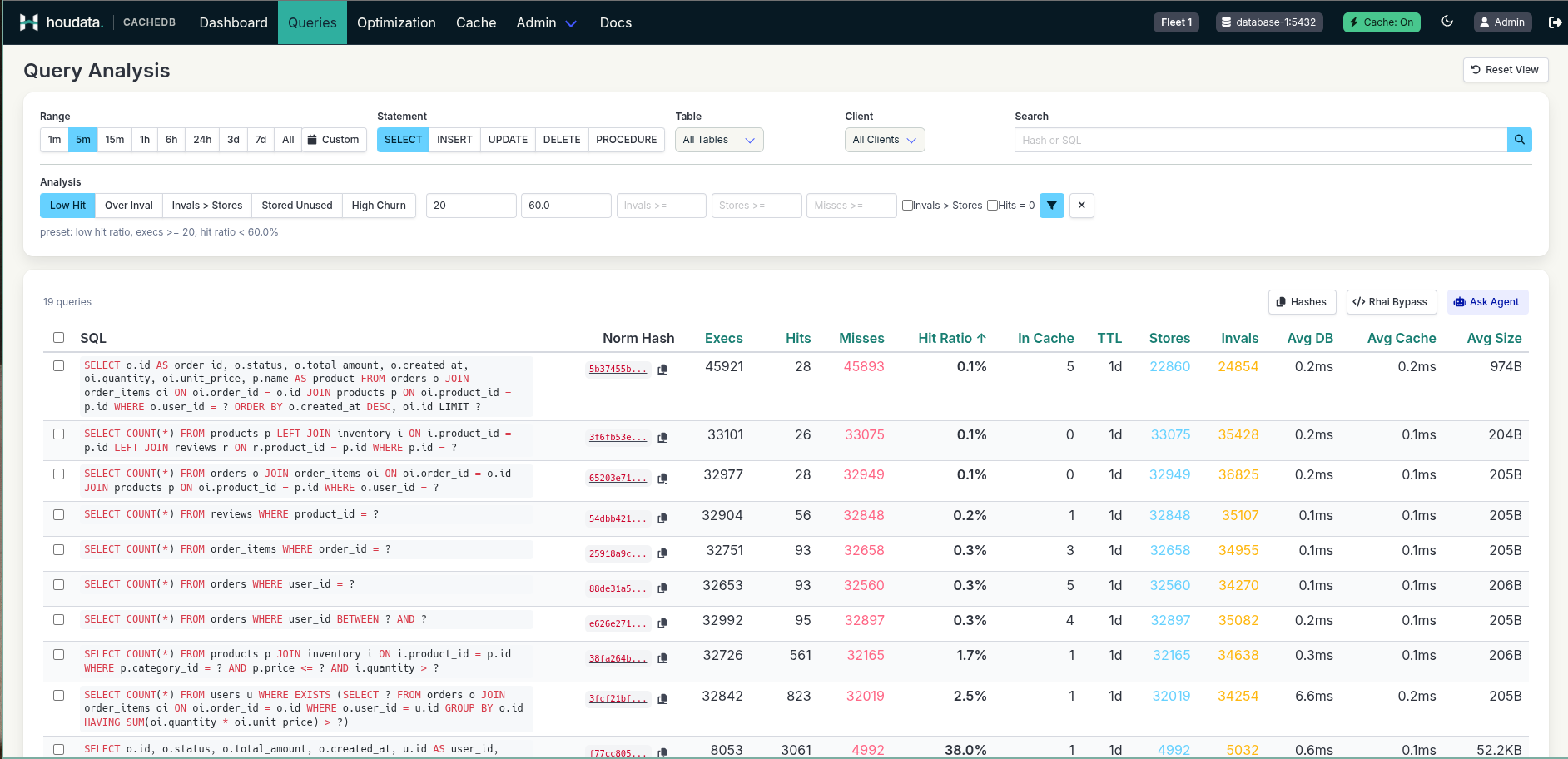
03 / Database offloading & cost reduction
Eligible queries can be answered from the shared cache instead of reaching the database on every request. That reduces repeated read work on the primary database and can lower its operating costs when less database capacity is needed.
Cache misses and writes still reach the source database. TTL and invalidation policy determine when a stored result can be reused.
Explore cache policyReuse a policy-approved result without repeating the backend read.
Fetch uncached results and apply writes through the native database path.
Your workload
Tell us which database path you want to cache, observe or offload. We can discuss the relevant policy and deployment model.