Plug & play caching
Add policy-controlled caching on the existing database path without rewriting application queries.
Explore this use case houdata.
CacheDB by houdata.
CacheDB is a transparent database proxy that observes repeated reads, reuses results where policy permits, and makes cache behavior visible to the operators responsible for the system.
The operating model
CacheDB sits between the application and the database. It preserves the client protocol, uses a distributed cache for eligible results, and routes every miss back to the source of truth. Multiple proxy instances can sit behind a load balancer while sharing a Redis Community, Valkey or Redis Enterprise cache.
Use cases
Explore three ways to apply caching and query visibility to an existing database workload.
Add policy-controlled caching on the existing database path without rewriting application queries.
Explore this use caseInvestigate query traffic and share operational signals with DBA and monitoring teams.
Explore this use caseServe eligible repeated reads from the shared cache, with potential to reduce primary database costs.
Explore this use caseCapabilities
Each capability is intended to be inspected against your database protocol, identity model, traffic pattern, and deployment boundary.
PostgreSQL, MySQL, SQL Server, IBM Db2 and Oracle proxies speak each database’s own wire protocol on both sides.
All proxies can observe traffic with result caching disabled, then enable cache behavior only where workload and policy support it.
Reuse eligible reads under explicit policy with Redis Community, Valkey or Redis Enterprise as the shared cache for proxy instances.
Review scripts that prepare SQL, decide cache eligibility and TTL, bypass reuse, or invalidate results after writes. Validate changes against real traffic before rollout.
Explore executions by client, backend and cache latency, hits and misses, and the writes that invalidate cached reads in the console.
Balance connections across multiple proxy instances for high availability. Each proxy keeps no shared local state; the cache is external.
Use console alerts with SMTP or HTTPS webhooks, export operational metrics to Prometheus for Grafana, and enable OIDC single sign-on for console access.
Terminate TLS from clients and establish a separate verified TLS connection to each database; plaintext requires explicit configuration.
Deploy in constrained environments with locally verified licensing and no control-plane dependency.
Compatibility
Every proxy speaks the database’s own wire protocol. Applications keep their existing database driver and SQL while changing the connection address.
| Database | Client protocol | Proxy | Transport |
|---|---|---|---|
| PostgreSQL | PostgreSQL | Native proxy | TLS 1.2+ on both legs |
| MySQL | MySQL | Native proxy | TLS 1.2+ on both legs |
| SQL Server | TDS | Native proxy | TDS TLS, including strict TDS 8.0 |
| IBM Db2 | DRDA | Native proxy | TLS 1.2+ on both legs |
| Oracle | TNS/TTC | Native proxy | TCPS on both legs |
Built for DBAs and monitoring teams
Start in transparent mode to see frequency and backend latency. In the console, inspect a query's executions by client and, when caching is enabled, compare hits, misses, cache latency and invalidations over time.
Use that evidence to review a cache rule and check its effect. Console alerts surface operational conditions; Prometheus exports fleet and cache metrics for dashboards in Grafana.
Explore console operations and integrations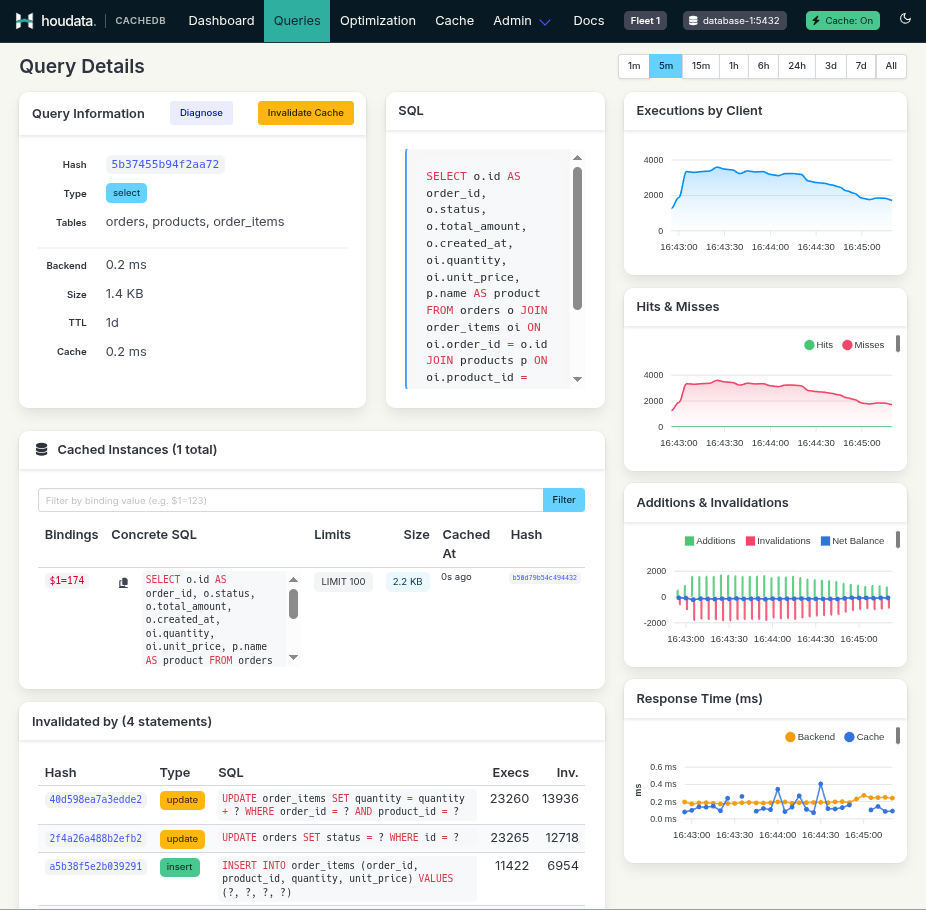
Designed with boundaries
Native database paths support TLS between the application and proxy and between the proxy and database. Cache connections do not support transport TLS, so protect them with a trusted network or network encryption layer. The web console is designed to sit behind a TLS-terminating reverse proxy or WAF.
Cache identity matters too: use separate cache namespaces for database identities with different data permissions.
Read the security boundariesTechnical conversation
Start with the database, client protocol, workload shape, and performance constraint you are actually responsible for.